Age
Record in yearsThis is a recorded input rather than a body measurement site.
Enter your current age alongside the physical measurements.
Method guide
Uses age and a gender-specific set of skinfold measurements.
Counts include age, weight and height when required.
How to measure
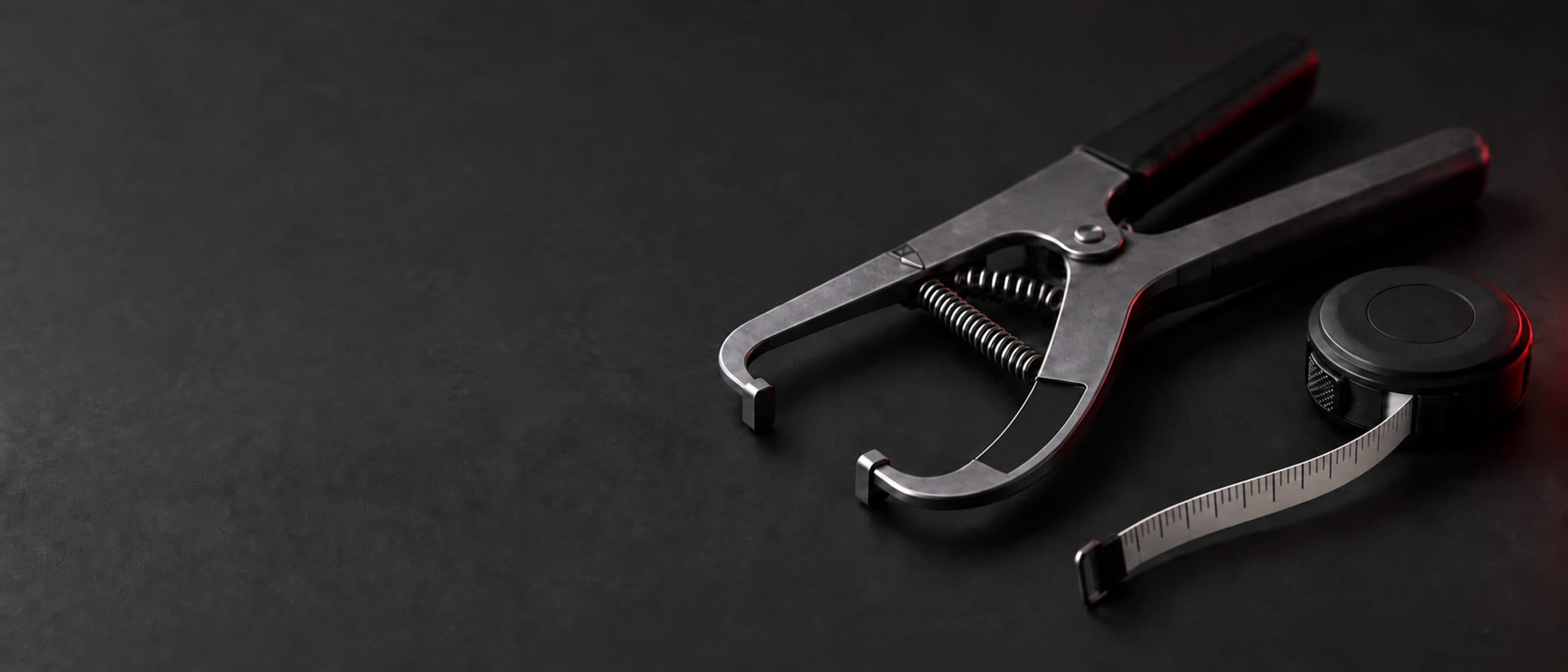
Use skinfold calipers on bare, dry skin. Mark every landmark before starting. Grasp skin and the fat beneath it between thumb and forefinger, lift the fold away from the muscle, and keep holding it while the caliper jaws close slightly below your fingers. The jaws stay perpendicular to the fold even when the fold itself is diagonal.
Measure every item listed for your calculation. Labels show when an input applies only to men or women.
This is a recorded input rather than a body measurement site.
Enter your current age alongside the physical measurements.
On the chest, between the armpit and nipple.
Fold direction: diagonal.
Mark the midpoint between the front of the armpit and nipple, then follow the natural diagonal fold.
On the back of the upper arm, halfway between the shoulder and elbow.
Fold direction: vertical.
Let the arm hang, mark the midpoint behind it, and lift vertically without tensing the triceps.
On the abdomen near the navel.
Fold direction: vertical.
Relax the abdomen, mark the same point beside the navel, and lift the fold away from the abdominal wall.
On the front of the thigh, halfway between the hip and knee.
Fold direction: vertical.
Unweight the measured leg, mark the midpoint, and lift the relaxed fold vertically.
Just above the upper edge of the hip bone.
Fold direction: diagonal.
Find the hip bone’s upper edge, mark just above it, and follow the natural diagonal fold.
Jackson & Pollock 3-Site has an estimated accuracy range of ±4–5% with proper technique. Use that range alongside the method’s practical limitations when deciding whether it suits your measurements.
Who it suits: People who want a shorter caliper session and can follow the correct gender-specific site set.
The trade-off: There are fewer folds to collect than in the longer Jackson & Pollock protocols, leaving less room for a poorly placed reading.
Uses age and a gender-specific set of skinfold measurements.
Jackson & Pollock 3-Site combines age with a gender-specific skinfold set. Men measure the chest, abdomen and thigh; women measure the triceps, suprailiac and thigh. Everyone also enters age.
This shorter protocol suits someone who wants a quick caliper routine and can reliably identify the correct landmarks. Its main tradeoff is that each reading carries practical importance in a compact input set, so speed should not replace careful placement and repetition.
The calculator turns the recorded inputs into a body fat percentage estimate. For Jackson & Pollock 3-Site, the estimated accuracy range is ±4–5% with proper technique. A range is not a promise that one reading is exact.
Treat the result as an estimate. When tracking changes, compare readings collected with the same method and procedure. A changed tool, landmark, body side, timing or operator can make readings less comparable. The number does not diagnose health or replace qualified advice, and formulas with different inputs are not interchangeable.
Ordered by typical error, lowest first. Counts include age, weight and height when required.
| Method | AccuracyTypical error against a reference method | Measurement count | Equipment |
|---|---|---|---|
| Parrillo | ±3-4% | 10 | skinfold calipers, a body-weight scale |
| Jackson & Pollock 7-Site | ±3-4% | 8 | skinfold calipers |
| Jackson & Pollock 4-Site | ±3.5-4.5% | 5 | skinfold calipers |
| Durnin & Womersley | ±3.5-5% | 5 | skinfold calipers |
| Jackson & Pollock 3-SiteCurrent method | ±4-5% | 4 | skinfold calipers |
| Covert Bailey | ±4-5% | 5 | a soft tape measure |
| U.S. Navy | ±4-6% | 3 for men · 4 for women | a soft tape measure, a reliable way to measure standing height |
| Modified YMCA | ±4-6% | 2 for men · 5 for women | a soft tape measure, a body-weight scale |
| YMCA | ±5-7% | 2 | a soft tape measure, a body-weight scale |
Review the sources and limitations behind Jackson & Pollock 3-Site on its paired research page.
View research →Take your prepared readings to Body Fat Calculator, select Jackson & Pollock 3-Site, and enter the measurements listed for your calculation.
PRO+ includes measurement history and progress tracking in the app. You can also sync app results with Apple Health on iOS when you enable the integration and grant permission.
Get the app →